Posted by iBuyLesPaul.com
March 9, 2026
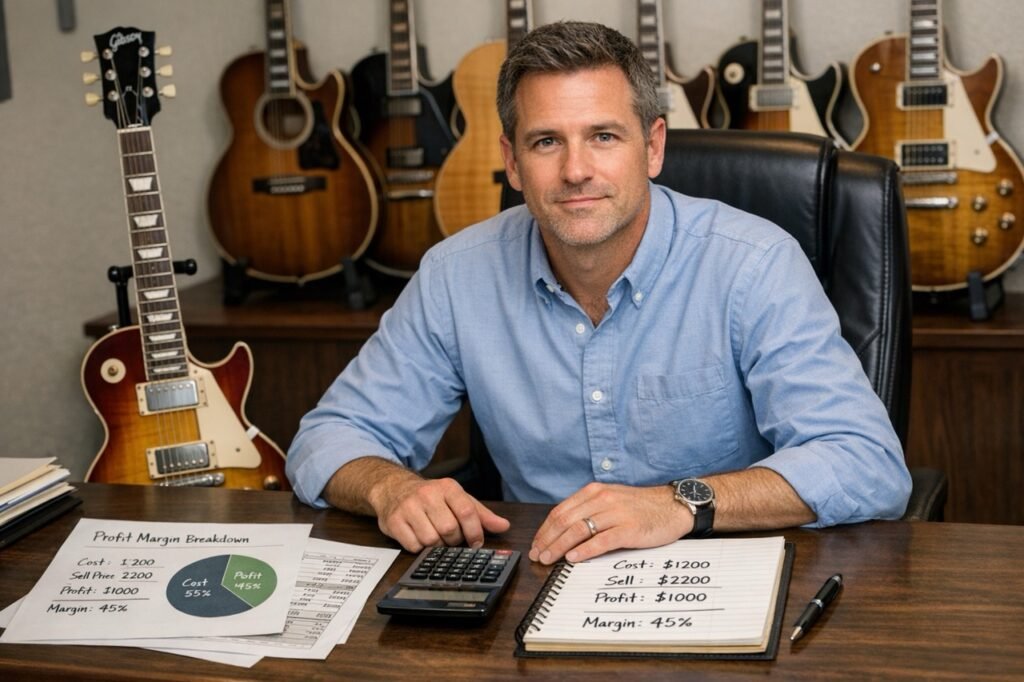
Let me tell you something most guitar buyers won’t: exactly how I determine what I’m willing to pay for your Les Paul.
No smoke and mirrors. No “I’ll have to check with my guy.” Just the actual formula I use every single time someone contacts me.
Why am I sharing this? Because the #1 thing I hear from sellers is: “How do I know if this offer is fair?”
Fair question. Here’s the honest answer.
The Formula Is Simple (The Execution Isn’t)
When you contact me about selling your Les Paul, here’s what I’m calculating:
What I can realistically sell it for – My costs and time – My margin = What I can offer you
Sounds simple, right? Let’s break down what those numbers actually mean.
What I Can Realistically Sell It For
This isn’t what someone listed a similar guitar for on Reverb. It’s what guitars like yours are actually selling for right now.
I track completed sales across multiple platforms. I know what a 2015 Les Paul Standard in honeyburst actually sold for last week (not what someone’s asking). I know which years are hot and which are sitting.
For a typical Les Paul Standard from 2010-2020 in good condition, the realistic resale range is usually $1,600-$2,200 depending on exact year, finish, and condition.
For Studios? $900-$1,400.
For Customs? $2,200-$3,500.
Vintage stuff? That’s a whole different calculation, but the principle is the same: what will it actually sell for, not what I wish it would sell for.
My Costs (Yeah, These Are Real)
A lot of sellers think I just flip guitars for pure profit. Here’s what actually comes out of every deal:
Reverb/eBay fees: 8-13% when I resell (yes, I pay the same fees you’d pay)
Payment processing: Another 3%
Shipping costs: $80-$150 per guitar if I’m shipping to a buyer
Photography and listing time: 1-2 hours per guitar to photograph, describe, and list properly
Storage and insurance: I’m holding inventory, which costs money
Repairs and setup: Most guitars need at least a setup ($75-$150). Some need fret work, electronics repair, or cleaning.
The guitars that don’t sell: Not everything moves quickly. Some sit for months, tying up my capital.
Let’s say I buy your Les Paul for $1,500 and sell it for $2,000:
- Reverb fees: -$160
- Payment processing: -$60
- Shipping: -$100
- Setup/cleaning: -$100
- Time (photography, listing, answering questions): -$50 worth of my time
Real profit: $1,530 out, $2,000 in = $470 actual profit
That’s on a good deal that sells quickly. On a guitar that sits for three months? My effective hourly rate drops to practically nothing.
My Margin (Here’s The Honest Part)
I need to make money. This is a business, not a hobby.
My target margin is 20-30% on most deals. On a $2,000 guitar, that means I’m looking to make $400-$600 after all costs.
Some people think that’s outrageous. Let me put it in perspective:
- Reverb/eBay sellers take 8-13% just for providing a platform
- Music stores on consignment take 25-40%
- Pawn shops offer 30-50% of value
- Online “instant quote” guitar buyers offer 40-60% of value
I’m typically offering 70-80% of realistic market value, handling everything myself, and taking on all the risk.
What This Means For Your Offer
So when I offer you $1,400 for your Les Paul Standard, here’s the reality:
- I believe I can sell it for $1,900-$2,000
- My costs will be around $300-$400
- My profit target is $400-$500
- You get $1,400 cash in 48 hours
Compare that to selling it yourself online:
- List at $2,200 (because you want $2,000)
- Wait 2-3 months
- Drop price to $1,900
- Pay $152 in Reverb fees
- Pay $65 in payment processing
- Pay $120 to ship it properly
- Spend 10+ hours managing the sale
- Net proceeds: $1,563
You made an extra $163 and spent three months doing it.
Or worse: you get scammed, the guitar gets damaged in shipping, or the buyer files a chargeback, and you’re out everything.
Why Some Offers Are Lower Than Others
Not all Les Pauls are equal. Here’s what drops my offer:
Condition issues: Every ding, scratch, or repair reduces resale value and my offer
Modifications: Swapped pickups, changed tuners, refinished—these kill resale
Oversaturated models: If there are 50 identical guitars on Reverb right now, I’m not paying top dollar
Slow-moving years: Some model years just don’t sell quickly, so I adjust
Missing parts: No case? No case candy? That costs me money to replace
A pristine, all-original 2008 Les Paul Standard in a desirable finish? I’m paying strong money because I know it’ll sell fast.
A modded 2003 Studio with buckle rash and no case? My offer reflects the reality that it’s going to sit for months at a lower price.
What I Won’t Do
Here’s where I draw the line:
I won’t lowball you hoping you’re desperate. If your guitar is worth $1,200, I’m not offering $600.
I won’t lie about condition to justify a lower offer. If I see an issue, I’ll tell you what it is and how it affects value.
I won’t play games. My offer is my offer. I’m not starting low expecting to negotiate up 40%.
I won’t waste your time. If I’m not interested or can’t make you a fair offer, I’ll tell you straight up.
The Real Value of Selling Direct
When you sell to me, you’re not just getting a lower price than retail. You’re getting:
Speed: Cash in 48 hours, not 3 months
Certainty: No risk of scams, damage, or chargebacks
Convenience: I handle pickup or shipping
Zero fees: You keep every dollar I offer
No hassle: No tire-kickers, no 47 “is this available?” messages
Expert evaluation: You know exactly what your guitar is worth
Is my offer going to be higher than what you’d theoretically get selling it yourself perfectly on Reverb? No.
But it’s going to be very close to what you’d actually net after fees, time, stress, and risk.
The Bottom Line
I make money by buying guitars below retail and selling them at market value. That’s the business.
But I make a sustainable business by being fair, transparent, and treating sellers with respect.
When I offer you $1,400 for your Les Paul, I’m not trying to rip you off. I’m offering you 75% of what I believe I can sell it for, and I’m taking on all the risk, time, and cost of reselling it.
You can absolutely try to get more selling it yourself. Sometimes that works out great. Sometimes it’s a nightmare.
But at least now you know exactly how I’m calculating my offer—and you can make an informed decision about what’s worth more to you: a few extra dollars or peace of mind.
Want to know what I’d actually pay for your Les Paul?
Send photos and details to iBuyLesPaul.com. I’ll give you a real offer with a real explanation of how I got to that number. No games, no pressure—just honest business.
Play what inspires you.
Sell what doesn’t.
That’s how great guitars keep making music.
One Response