Posted by iBuyLesPaul.com
February 16, 2026
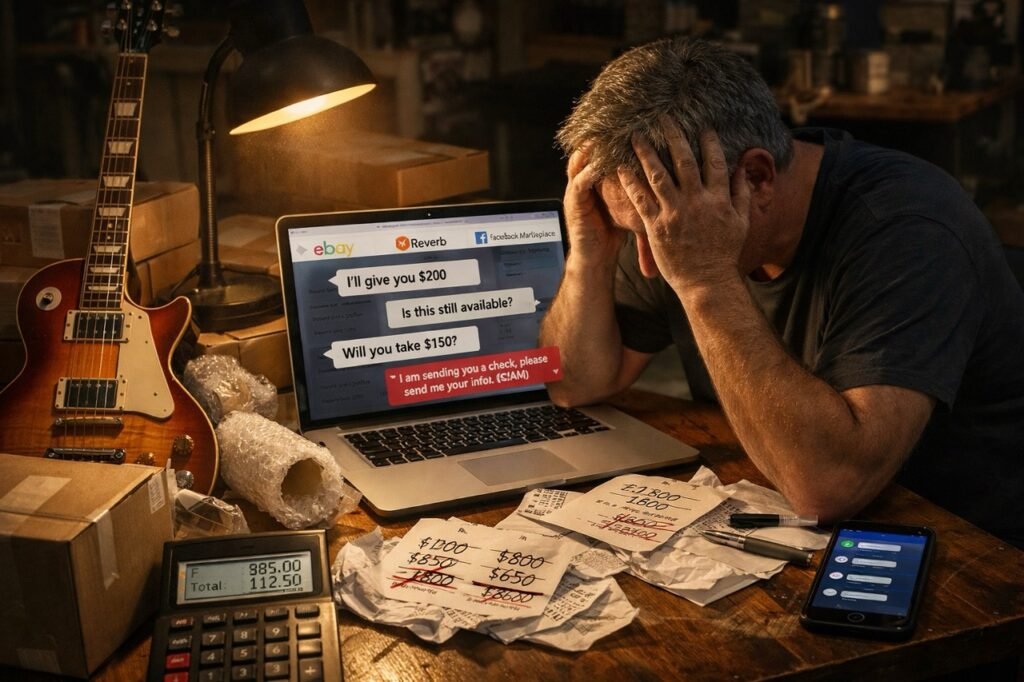
You’ve decided to sell your Les Paul. You snap some photos, write up a description, and list it on Reverb or eBay. Easy, right?
Three months later, your guitar is still sitting there. You’ve dropped the price twice. You’ve answered 47 messages, and 43 of them were either lowball offers, scammers, or people asking questions they could’ve answered by reading your listing.
The ones that seemed serious? They ghosted you after you spent 20 minutes answering their questions.
Welcome to selling a guitar online in 2025.
I talk to sellers every week who are shocked by how much it actually costs them to sell their Les Paul online. They thought they’d pocket $2,500. Instead, they netted $1,850, spent dozens of hours managing the sale, and aged five years from the stress.
Let me break down the real costs nobody tells you about.
The Obvious Costs (That Still Surprise People)
Platform Fees: The 15% You Forgot About
Reverb takes 5% + payment processing (usually another 3-4%). eBay? That’s 12.9% for musical instruments plus payment processing. Facebook Marketplace seems free until you realize you need to use their payment system for buyer protection, and there goes 5%.
Sell a Les Paul for $3,000?
- Reverb: You lose $240-$270 right off the top
- eBay: You’re down $387-$420
- Facebook Marketplace with shipping: Around $150 in fees
But wait—there’s more.
PayPal/Payment Processor Fees: The Double-Dip
Even if you’re selling locally and think you’re avoiding platform fees, most buyers want PayPal or Venmo for security. PayPal Goods & Services? That’s 3.49% + $0.49 per transaction.
On that $3,000 guitar, you just lost another $105.
Shipping: The Cost That Never Goes Down
Shipping a Les Paul properly isn’t cheap, and it shouldn’t be. You need:
- A hardshell case (if you don’t have one, add $100-$200)
- A solid shipping box (guitar-specific boxes run $20-$40)
- Proper packing materials ($10-$20)
- Insurance (for a $3,000 guitar, that’s $40-$80)
- Actual shipping ($60-$100 depending on distance)
Total shipping cost: $130-$240 if you’re doing it right.
And here’s the kicker: most buyers expect “free shipping” or at least split shipping. So you’re eating most of that cost anyway.
Listing Fees and Upgrades
eBay charges insertion fees if you list above their free monthly allowances. Want your listing featured or bumped? That costs extra. Need to relist because it didn’t sell the first time? More fees.
Reverb’s “free” until you realize you’re paying to bump your listing or promote it to actually get visibility.
The Hidden Costs Nobody Talks About
This is where it gets expensive.
Your Time (AKA The Biggest Cost You’re Ignoring)
Let’s track the actual hours:
Creating the listing: 1-2 hours
- Taking 15+ photos in good lighting
- Measuring everything
- Writing a detailed description
- Researching comparable prices
- Uploading and formatting everything
Answering questions: 3-10 hours (spread over weeks)
- “Does it come with a case?”
- “What’s the serial number?”
- “Can you take a photo of the back of the headstock in natural light?”
- “Will you take $1,800?” (for your $3,000 guitar)
- “My cousin said these are only worth $2,000, so…”
Negotiating: 2-5 hours
- Back and forth with serious buyers
- Countering lowball offers politely
- Explaining why your price is fair
- Dealing with buyers who disappear mid-conversation
Finalizing the sale: 1-2 hours
- Coordinating payment
- Arranging shipping or meetup
- Packing (if shipping)
- Creating detailed packing documentation
- Getting to UPS/FedEx
Conservative total: 10-15 hours minimum
What’s your time worth? Even at $20/hour, that’s $200-$300 in opportunity cost. Have a good job? Make that $500-$1,000 in time you could’ve spent working or, you know, living your life.
The “Price Drop” Tax
Here’s what actually happens with online listings:
Week 1-2: Your guitar sits at full price. A few views, no serious offers.
Week 3-4: You drop the price 10% to generate interest. Now you’re down $300 on that $3,000 guitar.
Week 5-6: Still nothing. You drop it another 10%. Now you’re at $2,430.
Week 7-8: Someone offers you $2,200, and you’re so tired of dealing with it that you accept.
You just lost $800 from your original asking price, plus all the fees we discussed earlier.
Scammers and Time-Wasters
Let’s talk about the people who will waste hours of your life:
The “I’m definitely interested” ghost: Asks 20 detailed questions over three days, says he’s “ready to buy,” then vanishes. You’ve just lost 2-3 hours.
The PayPal scammer: Sends you a fake PayPal confirmation email. You ship the guitar. The money never arrives. You’re out $3,000 and your guitar.
The chargeback artist: Buys your guitar, files a PayPal dispute claiming “not as described,” and now you’re fighting for 60 days while your money is frozen.
The local meetup flake: Sets up three different times to meet, cancels all of them, then stops responding.
The parts harvester: Makes you an offer, buys the guitar, swaps in cheaper pickups, then returns it claiming “it’s not authentic.”
I’ve heard every horror story. The guy who sold a ’72 Custom, shipped it, and the buyer swapped the neck with a Chinese copy before filing a return. The seller who met someone in a parking lot and got robbed. The woman who shipped her Les Paul Standard and it arrived with a cracked headstock—then fought with insurance for six months.
The Shipping Damage Nightmare
Even when you do everything right, shipping a guitar is playing Russian roulette.
FedEx and UPS throw packages. They really do. I’ve seen video footage of guitars being tossed 15 feet onto concrete. Your $3,000 Les Paul in a hardshell case? That’s a 30-pound projectile when a delivery driver is running behind schedule.
When (not if) damage happens:
The insurance claim process: 10+ hours of your life
- Filing the claim
- Providing documentation
- Taking detailed photos
- Following up repeatedly
- Potentially getting a lowball settlement
The angry buyer: Even if insurance pays, you’re dealing with an upset customer who now thinks you’re a scammer, is leaving negative reviews, and potentially filing disputes.
The replacement situation: If the guitar is totaled, you’ve lost the sale, paid for shipping twice, and now have a damaged guitar to deal with.
The Return Scam
Buyers have 30+ days to return on most platforms. Here’s what happens:
They receive your immaculate Les Paul. They gig with it for three weeks. It gets dinged, scratched, or worse. They file a return claiming “not as described” or “arrived damaged.”
Now you’re getting back a guitar that’s worth less than when you sent it, you’ve paid return shipping, and you’ve lost all the platform fees.
This happens more than you think.
Negative Reviews and Reputation Damage
One difficult buyer can tank your seller rating. Maybe they’re unreasonable. Maybe they had buyer’s remorse. Maybe they’re just having a bad day.
But that 1-star review stays there. “Seller was difficult to work with. Guitar not as described. Would not recommend.”
Now your future listings are tainted, and you’ll get even fewer serious buyers.
The Emotional Costs (Yeah, These Are Real)
The Stress of Strangers Having Your Address
When you ship a guitar, buyers have your address. When you meet locally, strangers know where you live or where you’ll be with thousands of dollars in cash or equipment.
I’ve talked to sellers who lost sleep worrying about meetups gone wrong.
The Anxiety of “Did I Price It Right?”
You lie awake wondering: “Did I leave $500 on the table? Should I have asked for more? Did I get scammed?”
Meanwhile, your guitar sits in shipping limbo for five days, and you’re checking tracking every hour.
The Guilt When Lowballing Yourself
You need the money now. You drop the price to $2,000 for a guitar you know is worth $2,800. A buyer jumps on it immediately.
Now you know you underpriced it, and that feeling sucks.
The Local Sale Isn’t Much Better
“I’ll just sell it locally and avoid all this!” you think.
Here’s what actually happens:
Facebook Marketplace/Craigslist:
- 90% lowball offers (“I got $500 cash right now”)
- Constant “Is this available?” with no follow-up
- People asking you to drive 45 minutes to meet them
- No-shows (plan on at least 2-3 before someone actually shows up)
- Safety concerns meeting strangers with expensive equipment
Local music stores (consignment):
- They take 20-30% commission
- Your guitar sits on their wall for months
- They’re pricing it at retail, not used prices
- You have zero control over negotiations
- Getting your guitar back if it doesn’t sell is a hassle
What Selling Online ACTUALLY Costs You
Let’s add it all up on that $3,000 Les Paul:
- Platform fees: -$240 to -$420
- Payment processing: -$105
- Shipping: -$180 (average, with you covering most)
- Your time: -$300 (conservative)
- Price drops: -$300 (you listed at $3,300, sold at $3,000)
- Risk of damage/scams: -$0 to -$3,000 (you got lucky)
Total cost: $1,125 to $1,305
What you actually net: $1,695 to $1,875 on a $3,000 sale
And that’s assuming everything goes smoothly, which it often doesn’t.
The Alternative Nobody Considers
Here’s what selling directly to a buyer like me looks like:
Your time investment: 30 minutes
- Send iBuyLesPaul.com photos
- Answer a few basic questions
- Accept or counter our offer
Your costs: $0
- No platform fees
- No shipping (I arrange pickup or pay for shipping)
- No payment processing fees
- No risk of scams or damage
- No returns or chargebacks
Timeline: 3-7 days from first contact to money in your account
What you net: Fair market value minus my margin
“But won’t you offer me less?” you’re thinking.
Here’s the math: If we offer you $2,400 for your Les Paul, and you would’ve netted $1,875 selling online after all costs and hassles, you’re actually ahead by $525.
Plus, you got paid in two days instead of two months.
When Online Selling Makes Sense
I’m not saying you should never sell online. Sometimes it’s the right call:
Sell online if:
- You have a truly rare or high-end guitar ($10,000+) where the extra hassle nets you significantly more
- You have time to spare and enjoy the process
- You’re already an established seller with a good reputation
- You’re in no hurry and can wait months for the right buyer
- You have experience dealing with shipping, insurance, and disputes
Sell directly if:
- You want a fast, clean transaction
- You value your time
- You don’t want to deal with scammers and tire-kickers
- You prefer certainty over gambling on the “best” price
- You’ve got a standard Les Paul model, not a rare collector piece
The Bottom Line
Selling a Les Paul online looks simple on the surface. It’s not.
Between platform fees, shipping costs, your time, price drops, and the very real risk of scams or damage, you’re often leaving money on the table—or worse, losing money compared to selling directly to an informed buyer.
I’m not saying this to scare you. I’m saying it because I talk to frustrated sellers every week who wish they’d known all this before they listed their guitar three months ago.
If you’ve got a Les Paul to sell and you want a straightforward transaction with zero hassle, zero fees, and zero risk, reach out. I’ll give you a fair offer based on current market value, and if we agree on price, you’ll have money in your account in days, not months.
No fees. No shipping headaches. No tire-kickers. Just a clean, professional transaction.
Tired of the online selling circus? Contact me at iBuyLesPaul.com with photos and details about your Les Paul. I’ll give you an honest assessment and a fair offer—usually within 24-48 hours. If you accept, we move fast. If you don’t, no hard feelings.
Sometimes the smartest move is the simplest one.
Play what inspires you.
Sell what doesn’t.
That’s how great guitars keep making music.